
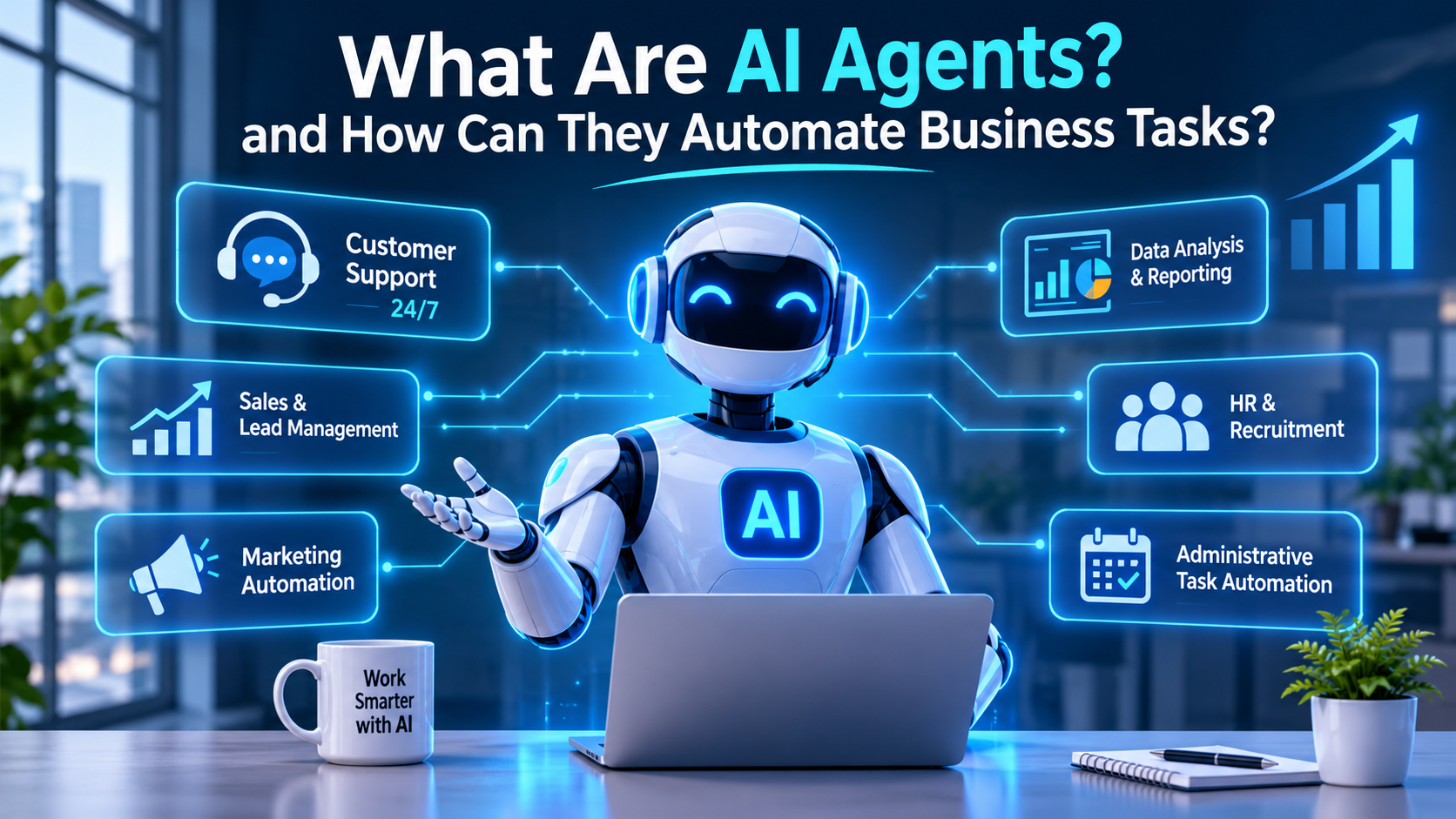
Artificial Intelligence is transforming the way businesses operate, communicate, and manage everyday activities. One of the latest developments in this field is AI Agents. Unlike traditional automation tools that follow predefined instructions, AI agents can understand goals, make decisions, perform tasks, and adapt to changing situations.
From managing customer inquiries to analysing business data, AI agents are helping organisations save time, reduce manual work, and improve productivity. As businesses increasingly adopt AI-powered solutions, understanding AI agents has become essential for professionals and organisations.
What Are AI Agents?
AI agents are intelligent software systems designed to perform tasks autonomously using Artificial Intelligence. They can understand user instructions, process information, make decisions, and take actions to achieve specific objectives.
AI agents use technologies such as Machine Learning (ML), Natural Language Processing (NLP), Large Language Models (LLMs), and automation tools to complete tasks with minimal human intervention.
For example, an AI customer support agent can answer customer questions, identify their requirements, provide relevant information, and escalate complex issues to human representatives.
How Do AI Agents Work?
AI agents typically follow a structured process to complete tasks:
- Understand the Goal: Interpret the user’s instructions or business requirements.
- Collect Information: Gather relevant information from databases, applications, or other sources.
- Make Decisions: Analyze available information and identify the next action.
- Execute Tasks: Perform actions such as sending emails, updating records, or responding to customers.
- Learn and Improve: Use feedback and available information to improve future performance.
How Can AI Agents Automate Business Tasks?
AI agents can support different business departments and improve operational efficiency.
1. Customer Support Automation
AI agents can respond to frequently asked questions, provide product information, manage customer inquiries, and offer 24/7 support.
2. Sales and Lead Management
Businesses can use AI agents to identify potential customers, qualify leads, send follow-up messages, and organize customer information.
3. Marketing Automation
AI agents can assist with content planning, campaign analysis, customer segmentation, marketing research, and performance reporting.
4. Data Analysis and Reporting
AI-powered agents can collect business data, identify patterns, generate reports, and provide insights that help businesses make informed decisions.
5. HR and Recruitment
AI agents can help screen applications, organize candidate information, schedule interviews, and answer employee-related questions.
6. Administrative Task Automation
From managing emails and scheduling meetings to updating spreadsheets and processing routine documentation, AI agents can reduce repetitive administrative work.
Benefits of Using AI Agents in Business
- Improved Productivity: Automate repetitive tasks and allow employees to focus on important activities.
- Time Savings: Complete routine operations faster with automated workflows.
- Better Customer Experience: Provide quick responses and continuous customer assistance.
- Cost Efficiency: Reduce manual effort and improve resource utilization.
- Data-Driven Decisions: Analyze business information and generate useful insights.
- Scalability: Support increasing business workloads without proportionally increasing manual operations.
AI Agents vs Traditional Automation
Traditional automation follows predefined rules and workflows. AI agents can interpret instructions, evaluate situations, and select actions based on available information.
For example, traditional automation may send the same email to every customer, while an AI agent can understand customer requirements and generate a more relevant response.
However, AI agents still require proper configuration, monitoring, security controls, and human supervision.
What Is the Future of AI Agents?
The future of AI agents is closely connected with business automation and intelligent digital transformation. As AI technologies continue to advance, businesses will increasingly use AI agents to manage complex workflows, improve customer interactions, and support decision-making.
Industries such as education, healthcare, finance, IT, e-commerce, and manufacturing are exploring AI-powered automation to improve their operations.
Professionals with knowledge of Artificial Intelligence, Generative AI, Python, Machine Learning, and automation technologies will have valuable skills in this evolving technology landscape.
Conclusion
AI agents are changing the future of business automation by making everyday operations smarter, faster, and more efficient. From customer support and marketing to sales and data analysis, they offer opportunities to simplify business processes and improve productivity.
Understanding AI agents and learning how to work with AI technologies can help businesses stay competitive in the digital world.
Frequently Asked Questions (FAQs)
1. What is an AI agent in simple words?
An AI agent is a software system that understands instructions, makes decisions, and performs tasks automatically using Artificial Intelligence.
2. Can AI agents automate business operations?
Yes. AI agents can automate customer support, lead management, email handling, marketing activities, data analysis, and administrative tasks.
3. What technologies are used to build AI agents?
AI agents commonly use Python, Machine Learning, Natural Language Processing, Large Language Models, APIs, and automation frameworks.
4. Are AI agents better than traditional automation?
AI agents offer more flexibility because they can interpret information and make context-based decisions, while traditional automation generally follows fixed rules.
5. Do businesses need technical knowledge to use AI agents?
Not always. Many ready-made AI agent platforms are available, but technical knowledge is beneficial for developing, integrating, and customizing advanced AI solutions.